Work

Jesa AI

Industry: EduTech / AI
Deliverables: Product Strategy, Design & Launch
Year: 2025
Jesa AI — Winner, Kelley AI PM Hackathon 2025
Turning dense MBA coursework into personalized, adaptive learning

Turning dense MBA coursework into personalized, adaptive learning

Jesa AI is an AI-powered study copilot built for MBA students drowning in dense course materials, tight recruiting timelines, and high-pressure exams. Built during the Kelley AI PM Hackathon, Jesa transforms any uploaded course document into personalized quizzes, adaptive flashcards, and multilingual video explainers, adapting in real time to each student's skill level.

We won the hackathon. But more importantly, we built something that solved a problem I lived every day as an international MBA student at Kelley.

Jesa AI is an AI-powered study copilot built for MBA students drowning in dense course materials, tight recruiting timelines, and high-pressure exams. Built during the Kelley AI PM Hackathon, Jesa transforms any uploaded course document into personalized quizzes, adaptive flashcards, and multilingual video explainers, adapting in real time to each student's skill level.

We won the hackathon. But more importantly, we built something that solved a problem I lived every day as an international MBA student at Kelley.

The problem we set out to solve

The problem we set out to solve

MBA students at Kelley face what we called the "triple burden": a crushing academic workload, relentless recruiting pressure, and high expectations for leadership and extracurricular involvement all at the same time.

MBA students at Kelley face what we called the "triple burden": a crushing academic workload, relentless recruiting pressure, and high expectations for leadership and extracurricular involvement all at the same time.

Turning dense MBA coursework into personalized, adaptive learning

Jesa AI is an AI-powered study copilot built for MBA students drowning in dense course materials, tight recruiting timelines, and high-pressure exams. Built during the Kelley AI PM Hackathon, Jesa transforms any uploaded course document into personalized quizzes, adaptive flashcards, and multilingual video explainers, adapting in real time to each student's skill level.

We won the hackathon. But more importantly, we built something that solved a problem I lived every day as an international MBA student at Kelley.

The problem we set out to solve

MBA students at Kelley face what we called the "triple burden": a crushing academic workload, relentless recruiting pressure, and high expectations for leadership and extracurricular involvement all at the same time.

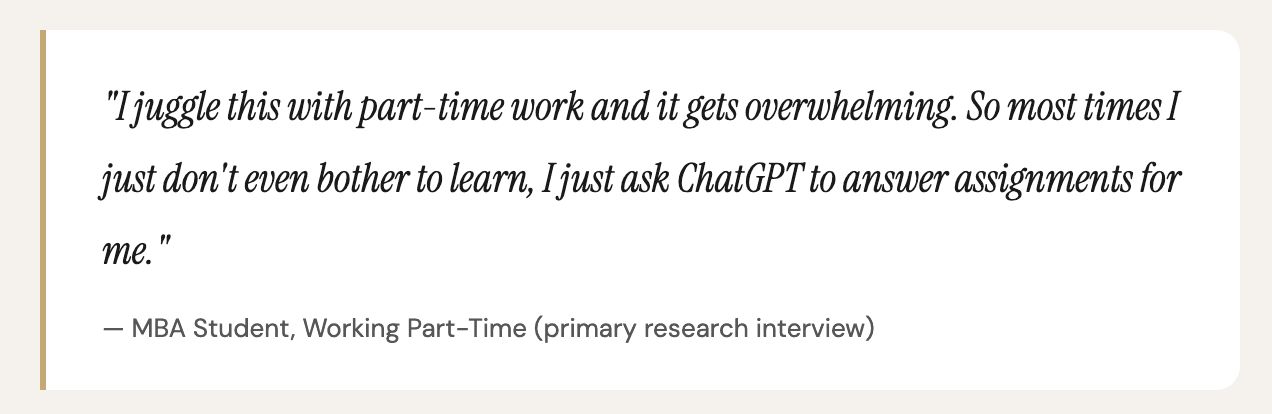
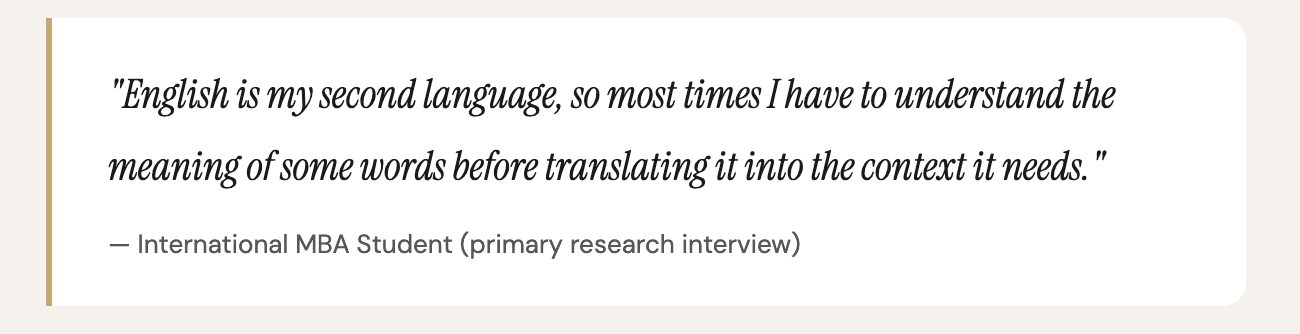
Through ten semi-structured interviews with Kelley MBA students, I uncovered three recurring pain points:

  • Dense course materials with no adaptive simplification

  • Technical concepts that were especially hard for career-switchers and international students

  • No integrated tool that combined quizzes, flashcards, and video in one place.

Through ten semi-structured interviews with Kelley MBA students, I uncovered three recurring pain points:

  • Dense course materials with no adaptive simplification

  • Technical concepts that were especially hard for career-switchers and international students

  • No integrated tool that combined quizzes, flashcards, and video in one place.

Current tools like ChatGPT, NotebookLM, and Quizlet each solved one piece of the puzzle but none of them adapted to student performance, generated multilingual video content, or grounded their outputs in the student's actual course documents.

Our solution

Our solution

Jesa AI ingests any course document (PDF, DOCX, PPTX) and transforms it into a complete, adaptive learning system. A student uploads their lecture slides, chooses their difficulty level and language, and Jesa handles the rest.

Jesa AI ingests any course document (PDF, DOCX, PPTX) and transforms it into a complete, adaptive learning system. A student uploads their lecture slides, chooses their difficulty level and language, and Jesa handles the rest.

Demo Video of Jesa AI

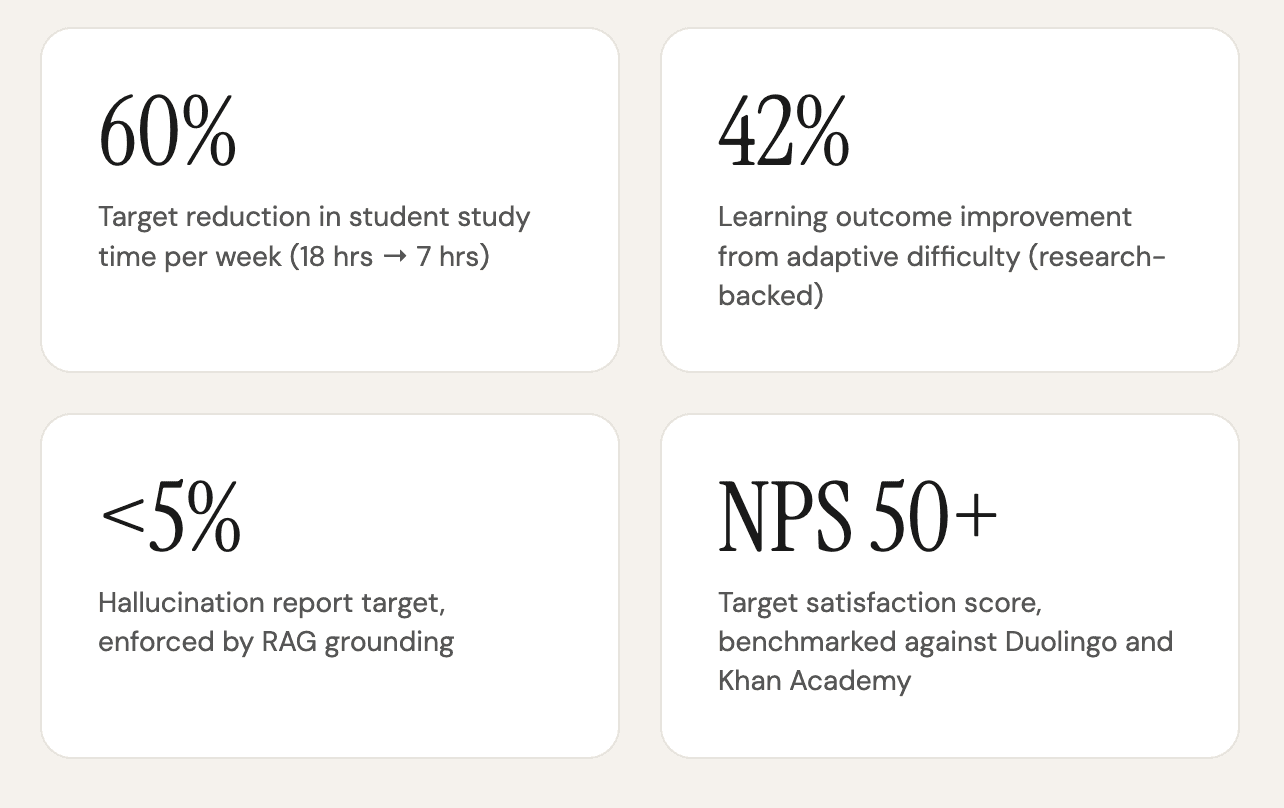
The adaptive difficulty engine uses Item Response Theory (IRT) via scikit-learn to continuously calibrate quiz difficulty based on each student's performance score. The RAG (Retrieval-Augmented Generation) framework ensures the AI only cites content from the student's own uploaded document, eliminating hallucination risk, which is the core failure of general-purpose tools like ChatGPT for this use case.

The adaptive difficulty engine uses Item Response Theory (IRT) via scikit-learn to continuously calibrate quiz difficulty based on each student's performance score. The RAG (Retrieval-Augmented Generation) framework ensures the AI only cites content from the student's own uploaded document, eliminating hallucination risk, which is the core failure of general-purpose tools like ChatGPT for this use case.

The AI system architecture

The AI system architecture

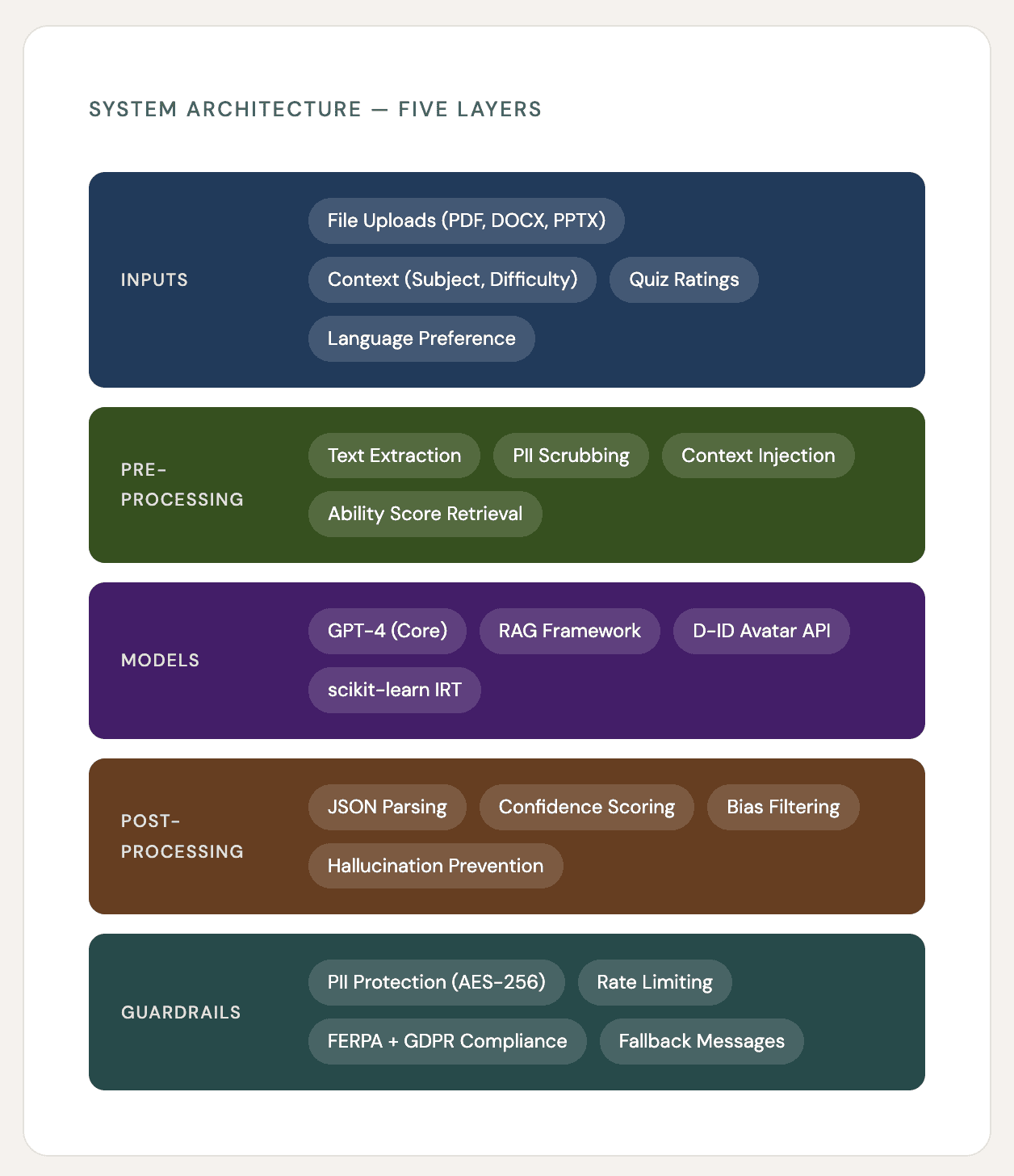
I developed the product strategy, PRD, and system architecture definition, designing the full pipeline across five layers: inputs, preprocessing, AI models, post-processing, and UX surface.

I developed the product strategy, PRD, and system architecture definition, designing the full pipeline across five layers: inputs, preprocessing, AI models, post-processing, and UX surface.

Snapshot of AI Architecture of Jesa AI
A key design decision was using RAG as our primary hallucination mitigation — not just a nice-to-have, but the core technical differentiator from ChatGPT. By forcing the model to ground all outputs in the student's uploaded document, we made Jesa provably more reliable for academic use.

A key design decision was using RAG as our primary hallucination mitigation — not just a nice-to-have, but the core technical differentiator from ChatGPT. By forcing the model to ground all outputs in the student's uploaded document, we made Jesa provably more reliable for academic use.

Success metrics we designed for

Success metrics we designed for

Lessons Learnt

Lessons Learnt

Lessons Learnt

Winning the Kelley AI PM Hackathon was a full validation of the approach, from how we researched the problem to how we designed the solution. But beyond the win, building Jesa AI sharpened how I think about AI product strategy in ways I carry into every project since.

What I learned

  • Responsible AI should always be a core product decision, not an afterthought. Privacy-first design, hallucination prevention through RAG, and FERPA compliance were built into the architecture from day one.

  • A tight problem scope wins. We did not try to replace the entire learning experience. We identified the exact moment students hit a wall and built precisely for that moment. That specificity is what won the hackathon.

  • User research drives technical decisions. Every guardrail, every model choice, every UX surface had a direct line back to something a real student told us in an interview.

  • Trade-offs are strategy. Choosing GPT-4 over cheaper models, capping video generations, using RAG over general prompting, each decision was a deliberate strategic call balancing cost, accuracy, and user value.

Team Credits

Team Credits

Team Credits

The team consisted of:

My team made it to the top 10 finalists out of over 200 applicants.
The team consisted of:

  • Ibrahim Salami: Product Designer II

  • Sultan Ayodele: UX Researcher

My team made it to the top 10 finalists out of over 200 applicants.
The team consisted of:

  • Ibrahim Salami: Product Designer II

  • Sultan Ayodele: UX Researcher

More work

More work

More work

(6)

© Semira Yesufu 2026

© Semira Yesufu 2026

© Semira Yesufu 2026

Create a free website with Framer, the website builder loved by startups, designers and agencies.